Poole Harbour Ospreys 2021

2021 is proving to be an encouraging year for the Poole Harbour Osprey Project, which we run in partnership with Birds of Poole Harbour and Wildlife Windows.

The long term aim of the project is to restore a population of Ospreys on the South Coast of England, where they have been absent for 200 years. This involves the translocation of young from nests in Northern Scotland. You can learn more about the project in our podcasts here.

Young Ospreys usually return to the UK for the first time in their third calendar year, and so this spring we were hopeful we would see some of the birds released in 2019 back in Dorset for the first time. Satellite tracking studies have shown that young Ospreys wander widely when they first return, but they usually visit their natal site (which in the case of the translocated birds is the release site) at some point during their first summer back in the UK. A key part of this behaviour is to prospect potential breeding sites, and, as a result, young birds often intrude at active nests. The movements of satellite-tagged male Rothiemurchus when he first returned to Scotland in 2011, is a good example of just how far young birds wander before they establish their own nest site.

In the early years of colonisation, it is usually males who establish territories, before attempting to attract a mate, but the difference for any returning male to Poole Harbour this year, was the presence of an unpaired female. CJ7 fledged from a nest in Rutland in 2015 and has returned to the Poole Harbour area each summer since 2017. It seems that the presence of translocated juveniles in the area has been a key factor in her settling in Dorset. She paired with a translocated bird, LS7, in 2019 but sadly the young male failed to return from migration last spring. Unperturbed, CJ7 has remained faithful to the same artificial nest for the past two summers and has laid unfertilised eggs on each occasion, demonstrating her eagerness to breed.

As those of you who have watched the Birds of Poole Harbour live stream this summer will know, there was great excitement on 18th May when CJ7 was joined at the nest by 022, a male that we had translocated from a nest in Strathspey in 2019. The two birds paired up immediately, and were seen mating regularly. It is highly unusual for two year-old Ospreys to breed, but we were hopeful that CJ7 may lay eggs in late May. That did not happen, but the two birds have remained together since, and, assuming they both return from migration, we are hopeful that they will attempt to breed next spring. What is not so certain is with nest they will choose – in recent weeks they have been seen at various artificial nests around Poole Harbour, and have been interacting with this year’s newly-released juveniles, even perching on nests with them.

022 (left) and CJ7 on the nest
The two birds began mating almost immediately

Whilst the key long-term aim of the project is to restore breeding Ospreys to the South Coast of England, early evidence is showing that this new population will also help to link different populations of Ospreys. The presence of translocated birds in and around Poole Harbour has led to CJ7 taking up residence in Dorset, while a female that we translocated to Poole has bred successfully in Wales for the first time this summer. 014, a female released in 2018 has bred for the first time this year at a nest at Pont Croesor in the Glaslyn Valley near Porthmadog in North Wales. She raised a single male chick (ring number 494), with a four-year-old male, Z2 or Aeron, from the Cors Dyfi nest in mid-Wales. Meanwhile a second female, 019, released at Poole Harbour in 2019, was also seen in Wales earlier this summer. She was captured on camera when she visited the nests in the Glaslyn Valley on 5th June. This was the first sighting of her back in the UK, although she was seen on a number of occasions at Gunjur Quarry in The Gambia during her first winter and again in March this year. She was subsequently seen at Cors Dyfi further south in Wales on 30th June and possibly again on 5th July. This demonstrates how widely young birds wander when they first return; helping them to develop important knowledge of where other Ospreys are breeding. It will be very interesting to see if and where the young female appears next spring. Research has shown that male Ospreys typically breed close to their natal site, but females often disperse further, and so it is possible that 019 may follow 014’s lead and also return to Wales in future years to breed. Or should another translocated male return and set-up territory at Poole Harbour, we may yet see her back in Dorset.

019 at Gunjur Quarry in The Gambia in January 2020 (photo by Chris Wood)

A key element of the project at this early stage is the continued release of young birds, and during July we translocated a further ten juvenile Ospreys from nests in Moray and Highland. The young Ospreys are collected under a special licence issued by NatureScot from broods of two or three and then held temporarily at Roy Dennis’s home near Forres, before being transported by road to Dorset. You can hear more about our work collecting Ospreys by listening to one of our podcasts from 2019 here.

Once the birds had arrived at Poole Harbour on 15th July they were immediately moved into holding pens and monitored by the Birds of Poole Harbour team. CCTV cameras enable the birds to monitored closely during this period and released when appropriate. The first five birds were released on 2nd August with the remaining younger birds making their first flights ten days later.

Two of the translocated juveniles feeding after release. Magpies often take advantage of a free meal at the release site too.

The post-release period is critical in the imprinting process because it is when the young Osprey learn that Dorset is home. They generally remain close to the release pens for the first ten days, before venturing further a field and exploring the wider landscape. Fresh fish is provided by the team on a daily basis in order to replicate what happens at natural nests, and so even when the young birds make longer exploratory flights, they usually return in the evening to feed. Most young Ospreys do not catch their own fish until they depart on their first migration, and so the fish provided by the project team is essential in helping the birds to get into the best possible condition for the long flight south.

In the last few days the juveniles have been seen in the presence of CJ7 and 022. At Rutland Water there were instances of non-breeding adults feeding translocated juveniles, and we wonder if that may be repeated in Dorset this summer. Both 022 and CJ7 tolerate food-begging juveniles perching on artificial nests with them, and it will be interesting to see if they respond to the incessant food-begging, by providing fish. Regardless, the presence of the young birds will further strengthen the very strong bond that both CJ7 and 022 already have to the area.

Translocated juvenile 375 food begging to 022 (left) and CJ7 on an artificial nest at Poole Harbour

This year’s juveniles are likely to remain at Poole Harbour until early September before setting off on their first migration. An excellent way of seeing them before they depart is to join one of the Birds of Poole Harbour Osprey cruises. You can find out more here.

White-tailed Eagles at Ken Hill

We are delighted that Natural England have granted a licence for the Foundation and Wild Ken Hill to reintroduce White-tailed Eagles to West Norfolk and the surrounding region. 

The go ahead has been given after the project team completed a detailed feasibility study, alongside a public consultation which took place during January and February. 91% of participants gave their support for the proposals, including 83% of people who were “strongly supportive”. 63% of farmers also indicated support for the proposals. The complete feasibility study, including results of the consultation can be downloaded from our website here

The West Norfolk project will become the next phase of national efforts to restore White-tailed Eagles to England, which began with the release of birds on the Isle of Wight in 2019. That project is a partnership between the Foundation and Forestry England, and you can read the latest updates on our website here.
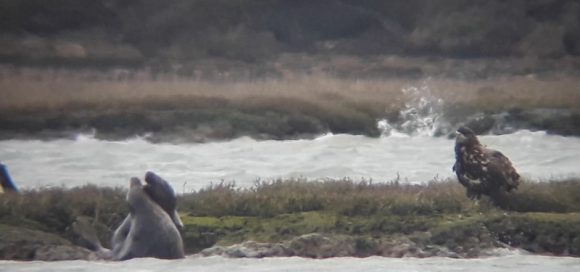
The Natural England licence will allow up to 60 juvenile birds to be released at Wild Ken Hill over a ten year period, with the aim of establishing a small breeding population of 6-10 pairs in the region. White-tailed Eagles usually do not breed until they are five years of age, and so it will take some time for the population to become established. 

The juvenile birds will be translocated from Poland, where there are over 1,000 pairs of White- tailed Eagles. Current complications with international travel under Covid-19 restrictions mean that the first birds are likely to be released in 2022. 

Also known as the sea eagle, the White-tailed Eagle is a native bird of prey, and the UK’s largest, with a wingspan of 8ft (2.4m). It was persecuted to extinction in Britain in the early twentieth century. The species has subsequently been successfully reintroduced to Scotland, and more recently, Ireland. 

We are delighted to be working on the project with Wild Ken Hill, a conservation and sustainable farming project on the West coast of Norfolk. You can read more about their work on their website.

Dominic Buscall, manager at Wild Ken Hill, said, “We are delighted to have the go ahead to bring back White-tailed Eagles to Eastern England, and overwhelmed by the support we have received from all sectors. We have also carefully been listening to concerns where they have arisen, and we are now committed to delivering this important conservation project and working with all of our stakeholders to ensure its success.” 

G393, here seen with a Red Kite, spent five months in West Norfolk from 1st August 2020- 4th January 2021 before returning to the Isle of Wight (photo by Tim Smith)

Roy Dennis who has been instrumental in the recovery of the species in the UK, said, “This is the next logical step to restore this magnificent bird to England and compliments efforts across Europe to help the species. We have carefully considered the potential ecological and socio-economic impact of the project and initial results from the Isle of Wight, and evidence from across lowland Europe, shows that this is a bird that can live successfully alongside people and fit into the East Anglian landscape very well.” 

Dave Slater, director for wildlife licensing at Natural England, said: “After thorough consideration, we have granted a licence allowing the Roy Dennis Wildlife Foundation to release white-tailed eagles at Wild Ken Hill in Norfolk. Our experts have carefully assessed the project against guidelines for the reintroduction of species, as well as the potential environmental, social and economic impacts. And we are satisfied that there are no significant risks associated with it. We’re content that the applicant’s experience, as well as our expertise and licensing process, ensures the project will be carried out in a responsible, well-managed way that takes account of concerns and makes a positive contribution to both people and wildlife.” 

The project is now running a crowdfunding campaign to raise money for the initial costs. 

A viable population on the East coast centred around West Norfolk would help to connect existing White-tailed Eagle populations in Scotland, Ireland – also established through reintroduction projects – with those in the South of England, and mainland Europe, including the Netherlands, Denmark, and Germany. 

Indeed, six juvenile birds released on the Isle of Wight have spent periods of time in Norfolk over the last year in addition to others from the continent, demonstrating the suitability of the area for the species. One of the Isle of Wight birds subsequently crossed the English Channel and is now in Denmark. 

Roy Dennis said, “The breeding biology of White-tailed Eagles means that although young birds range extensively in their early years, they usually return to their natal area to breed. However, if, in the future, young birds from other populations encounter a small breeding population of White-tailed Eagles in East Anglia, they may be encouraged to stay.” 

White-tailed Eagles are opportunistic predators with a preference for fish, waterbirds, and for carrion. No issues with conservation sites or farming systems have been recorded with any of the 13 birds released on the Isle of Wight to date. 

Wild Ken Hill was chosen for the next phase of national efforts to bring back the bird because of its coastal location as well as its quiet woodlands, which together provide highly suitable loafing areas for young birds post-release, and in time, nesting locations.

G383 at the Ken Hill Estate in September 2020 (photo by Tim Mackrill)

Crossing the Channel

The key aim of the White-tailed Eagle project on the Isle of Wight, which we run in partnership with Forestry England, is to restore a breeding population to the South Coast for the first time since the late 1700s. This, we hope, will provide an important link between existing populations in Scotland and Ireland with those in continental Europe.  There has been a marked upturn in the number of sightings of wandering White-tailed Eagles from continental Europe in England during the last two springs, and while these young birds are likely to eventually return to their natal areas, some may stay if they encounter a breeding population on the South Coast.  Similarly, we expect young birds from the Isle of Wight to venture across the English Channel, particularly in their early years. While most are likely to return to the South Coast as they approach breeding age, it is possible that some will join the expanding populations in countries such as the Netherlands, France and Germany. With this all in mind, it was very significant that, on 6th April, G463, a 2020 male, was the first Isle of Wight bird to make it across the English Channel, as Tim Mackrill explains.

G463

After wintering near Chard in Somerset, G463 was one of three Isle of Wight birds to spend time in East Anglia this spring. The young male arrived in early March and spent three weeks in the Brecks and West Norfolk. He was photographed at Thornham beach on 19th March before returning south to the Brecks that afternoon. Next morning he was on the move again, and flew south-east to the Suffolk coast near Southwold. The Suffolk estuaries are another superb area for White-tailed Eagles, and G463 spent time at the mouth of the River Blyth at Southwold on 21st March, before heading further south along the coast to the River Alde, between Aldeburgh and Orford Ness where he remained until the morning of 25th March.

G463 receiving unwanted attention from a Carrion Crow on Thornham Beach in Norfolk (photo by Richard Campey)
G463 being mobbed by a Common Buzzard in West Norfolk (photo by Andy Bloomfield)

On 25th March G463 flew north along the Suffolk coast, passing over Minsmere at 10:15 and then Lowestoft just before midday. He then headed into the Broads and spent four days in the Horsea area until 29th. G463 subsequently headed west along the North Norfolk coast and returned to his favoured areas in West Norfolk before moving south back to the Brecks on 1st April. The next morning he crossed back into Suffolk and then spent two days around Ampton Water north of Bury St Edmunds.

G463’s explorations in Norfolk and Suffolk during March and April

G463 was on the move again on 4th April, passing over Bury St Edmunds at 15:05 before heading south-east into Essex. He was over Colchester at 17:05 and then the Colne Estuary soon afterwards. The young male then headed north back into Suffolk and spent the night in woodland near Alton Water to the south of Ipswich. The next morning G463 initially flew north to Stowmarket, but strong north-westerly winds then encourage him south again. He crossed the mouth of the River Thames at 12:30 and the Isle of Sheppey soon afterwards. By 13:30 he had reached the south Kent coast at Dover and that afternoon flew 7 km out into the English Channel at an altitude of over 700 metres, before turning back again.

That night G463 roosted 10 km (6 miles) inland, but was back on the coast at 08:30 the next morning. At 09:52 he was 7 km out to sea once again but, like the previous afternoon, subsequently returned to land. He then flew south-west along the Kent coast to Dungeness. At 13:02 he was circling 1382 metres above and with a strong north-westerly wind providing perfect tailwind assistance, he headed out across the Channel a few minutes later. The transmitter logged the bird’s location every five minutes as G463 crossed the sea and showed that by 13:22 his altitude had dropped to 404 metres, but at the point of the next GPS transmission he had succeeded in gaining altitude to 582 metres. G463 continued on the same south-easterly course before making landfall just to the north of Boulogne-sur-Mer at 13:45, having completed the 47 km (29 mile) crossing in just 40 minutes at an average speed of 70 kph (43 mph).

G463 circled up to an altitude of 1382 metres over Dungeness before heading across the English Channel
G463 took just 40 minutes to make the Channel crossing

After reaching French airspace, G463 continued to make good progress and flew a further 176 km (109 miles) south-east through France, eventually stopping to roost in a small wood near the village of Douilly in the Picardy region, at 19:40 local time.

G463’s flight between 6th and 8th April

Next morning the wind had changed to a south-westerly and this perhaps influenced a distinct change of course for G463. After leaving his roost site at 06:55 the young male headed north-west towards the Ardennes Forest. By 12:40 he was flying close to the Belgian border, and eventually crossed into Belgian airspace near the town of Givet an hour later. As the afternoon progressed G463 turned to a more northerly heading and eventually stopped to roost in a forested area just to the south of Liege having flown 237 km (147 miles) during the course of the day.

On 8th March G463 left his roost site at 08:00 and again headed north, skirting around the west side of Liege and then on towards the Netherlands border. He passed into Dutch airspace just after midday and headed NNE, following the course of the Meuse River for 30 km before crossing into Germany at 13:30. He continued flying north for less than an hour before stopping in woodland on the south side of the River Rhine having flown 158 km (98 miles) during the course of the day.

On 9th April G463 left his roost site at 07:30 but stopped again in farmland nearby soon afterwards. He eventually resumed his journey at 11:00, crossing the Rhine and then heading north-east through the German regions of Münster and then Lower Saxony until 14:30 when he stopped in an area of woodland and arable farmland near the town of Herzlake. G463 remained in the local area for the rest of the afternoon, but had still covered 154 km (95 miles) in just 3.5 hours of flying.

G463 remained in the local area for the whole of the next morning, but then headed north again at 13:00, flying 39 km (24 miles) north to Leegmoor, a wetland nature reserve. He roosted locally and then remained in the area all day on 11th .

On 12th April G463 was on the move again. He set off from Leegmoor in a north-easterly direction shortly after 10:00 and reached Jade Bight, a bay on the Wadden Sea coast at midday. He then skirted around the southern end of Bremerhaven before continuing north-east, pausing in a forested area south of Wingst, north-west of Hamburg, for four hours between 14:10 and 18:10, before continuing a little further north to a small wood on the south side of the mouth of the River Elbe. By the time he went to roost G463 had flown another 158 km (98 miles) during the course of the day, and was now just south of Schleswig-Holstein the most northerly of the 16 German states and a stronghold for White-tailed Eagles in Germany. G463 will now be encountering many other eagles on his travels.

G463’s flight through Germany, 8-12 April
G463’s travels since 1st March

G463 remained on the south side of the River Elbe all day on 13th April. This is an excellent place for the young male to spend some time, and it will be fascinating to see how long he lingers in the area, and if and when, he heads back towards the Isle of Wight.

G463 remained on the south side of the River Elbe all day on 13th April

G405

G463 is not the only Isle of Wight bird to wander a considerable distance this spring. Female G405 has also ranged extensively, but unlike her compatriot from the 2020 cohort, she returned to the Island yesterday after a month of explorations that took her as far north as East Lothian in southern Scotland.

In our previous update we reported that G405 had spent much of February and early part of March at Longleat in Wiltshire. She subsequently returned to the Isle of Wight via Dorchester and Poole Harbour on 16th March, but only remained on the Island for three days before heading north again back to Longleat on 19th March. She completed a short circuit of Warminster and Westbury on 21st, but then made a more determined movement to the north-east on 22nd, flying 132 km (84 miles) to south Northamptonshire. Interestingly that night she roosted in the same wood near Silverstone as 2019 female, G318, had a few weeks earlier.

A brisk south-westerly wind encouraged G405 to continue north-east the next day and by 10:40 she was over Tallington in south Lincolnshire, flying at an altitude of 583 metres. She continued on the same heading through the Lincolnshire Fens towards Mablethorpe before turning north-west to head into the Lincolnshire Wolds. That night she roosted in a small wood near the village of Burgh on Bain having flown 193 km (120 miles). The next day G405 made a shorter movement of 40 km (25 miles) to the north-west and roosted in Laughton Woods in north-west Lincolnshire.

G405 left her roost site soon after first light on 25th March and headed north-west into South Yorkshire and then north towards York. At 11:30 she was 12 km (7 miles) east of the city, flying purposefully north at an altitude of 717 metres, and an hour later she was photographed circling over Appleton-le-Moors. She subsequently headed north-west into the North York Moors having flown 118 km (73 miles) from Lincolnshire.

G405’s flight to the North York Moors

G405 remained in the south-west of the North York Moors for six days, and in that time favoured an area frequented by G318 last year, tending to remain on the lower slopes rather than the open moors.

On 31st March she flew 123 km (73 miles) west to the Yorkshire Dales and roosted in woodland south-west of Cowgill in Cumbria. The next morning she flew north the western part of the Yorkshire Dales and then into the Lake District. She was perched just to the north of Haweswater, between 12:22-12:37, close to the area where Golden Eagles used to breed, but then continued north again, passing the east end of Ullswater at 13:15 and then to the east of Carlisle at 14:25. She then crossed the border into Scotland at 16:00 before stopping in woodland 10 km (6 miles) north-west of Kielder Water, having flown 170 km (105 miles) from the Yorkshire Dales.

G405 passed Haweswater and Ullswater in the Lake District on 1st April
G405’s flight north through the Yorkshire Dales and the Lake District, 31st March – 1st April

G405 remained in the local area on 2nd April, but then headed further north on 3rd April, passing Jedburgh at 11:45 and then completing a circuit of the Lammermuir Hills, where G324, a 2019 female had summered last year. At 14:45 G405 was at the most northerly point of her journey, 587 km (367 miles) north of the release site on the Isle of Wight. At this point she began heading south again, and eventually stopped in woodland 4 km (2.5 miles) south-east of Selkirk having flown 147 km (91 miles).

The next morning G405 headed slowly south-east and crossed the border back into England at 12:20. She then continued south-east through Northumberland before roosting in woodland just north of Rayburn Lake after a flight of 70 km (43 miles).

G405’s movements in Scotland and northern England 2-4 April

Having initially been encouraged north by southerly winds, a distinct change in the weather to cold northerly winds appeared to prompt G405 to head south again. She left her roost site at first light on 5th April and flew purposefully south, passing directly over Newcastle at an altitude of 601 metres at 09:47 and then to west of Middlesborough at 10:30. By 11:00 she was back in the North York Moors, and she flew a wide arc around the east side of the moors before stopping in Dalby Forest soon after midday, having already flown 170 km (105 miles). She remained in the local area for the rest of the afternoon and then next morning flew 7 km (4.5 miles) south before spending the day beside the River Derwent west of Yedingham.

G405 flew south through the North-East on 4th April

On 7th April G405, again encouraged by northerly winds, was on the move again. At 11:40 she was 21 km (12 miles) south-west and now back on the exact track that she had used to fly north. She followed an identical route for 48 km (30 miles) and then continued on the same SSW heading over Worksop in Nottinghamshire at 13:36 (997 m altitude) and then Nottingham between 14:10-14:26. She subsequently skirted around the east side of Leicester and then directly over Market Harborough between 15:13-15:18 at an altitude of 469-499 m. At 15:43 she was just to the east of Northampton (840 metres) and then over Milton Keynes at 16:13 (630 m). She continued south, aided by the strong wind and skirted around the west side of Tring between 16:43 and 16:48 (207-338 m) before finally stopping in woodland to the west of Amersham at 17:25 having flown an impressive 323 km (201 miles) from North Yorkshire.

G405 used an almost identical route south through Yorkshire as her northward journey in March
G405 flew 323 km (201 miles) south on 7th April

Next morning, G405 headed south-east towards London, and was flying at an altitude of 466 metres to the west of Wembley. At 11:15 she was directly over the River Thames to the east of Richmond at a low altitude of just 154 metres and she was then photographed by Ian Jones as she passed over Beddington Farmlands in south London at 11:50. Once past the capital she continued south-east into Surrey, Kent and then East Sussex. At 14:05 she was just 12 km (7.5 miles) north of the South Coast but at that point she turned to the east and flew back into Kent before settling to roost in Park Wood, north-west of Elham and east of Ashford, having flown another 188 km (117 miles).

G405 flew over London on 8th April

Next morning, 9th April, G405 flew 22 km (14 miles) to the East Kent coast at Pegwell Bay and remained there for three hours before returning to the same area as the previous night to roost. She then lingered in the local area for all of the next day, before heading west on the morning of 11th April, passing just to the north of Rye Harbour at 10:15 and then north of Lewes at 11:40. She spent two hours near Plumpton during the middle of the day before continuing west and eventually stopping in Westdean Woods the South Downs north of Chichester.

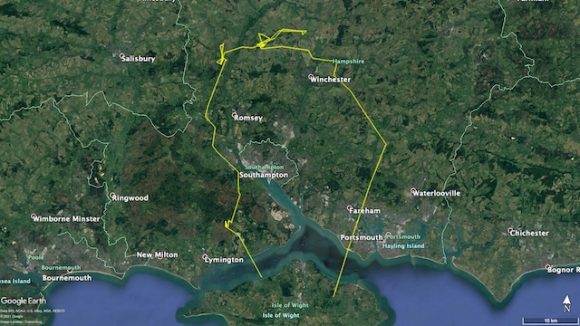
G405 remained around Westdean Woods all day on 12th April but then headed south on the morning of 13th. She crossed Thorney Island at 10:30 and then headed west to the north of Portsmouth and then across Southampton Water. At 12:30 she was close to Lyndhurst in the New Forest and she then headed south to Lymington before crossing the Solent back to the Isle of Wight after just under four weeks away, have flown 2279 km (1416 miles) in that time.

G405’s flight back to the Isle of Wight on 13th April
G405 flew 2279 km (1416 miles) between 19th March and 13th April

G405’s return to the Isle of Wight is another demonstration that the translocated birds regard the Island and the South Coast as home. This is also evident in the differing behaviour of the 2019 and 2020 cohorts during the past month. After wandering extensively last year, the four 2019 birds are now spending all of their time either on the Isle of Wight or neighbouring areas of the South Coast. It is particularly encouraging that male G274 and female G324 seem to be forming a pair, and are spending most days together in coastal locations around the Isle of Wight. They have been observed catching both marine and freshwater fish on a frequent basis as well as Coot, Black-headed Gulls and even an injured Canada Goose. They also appear to be keeping the other two 2019 birds, G393 and G318, away from the Island wherever possible. This is the first indications of territorial behaviour, and is another encouraging sign for the future.

G274 and G324 have spent most of the past month together on the Isle of Wight (photo by Ainsley Bennett)

In contrast all of the 2020 birds continue to explore extensively. G461 has ranged along the whole of the South Coast from Kent to Cornwall in the past month, while female G466 has travelled west to Cornwall, completed a circuit of East Anglia and, most recently, was flying north through County Durham this morning. G471, meanwhile, has spent the majority of the past month in East Anglia, favouring the North Norfolk coast and also the Ouse Washes in Cambridgeshire, but then flew south-west today and was heading into Herefordshire at 17:00. G408 has generally remained more local, but visited the Somerset coast near Burnham-on-Sea on 4th April and has also spent prolonged periods in the Arun valley in West Sussex where he has been joined, on occasions, by 2019 male G393. These movements are typical of young White-tailed Eagles during their second calendar year, but the satellite transmitters are providing a fascinating insight into their daily explorations. It has also been excellent to hear about sighings of the birds on their travels – very many thanks to everyone who has been in touch and sent photos.

G471 has spent much of the past month in East Anglia (photo by Andy Bloomfield)
All of the 2020 birds have ranged extensively during the past month
(G405 = blue; G408 = white; G461 = purple, G463 = green; G466 = yellow; G471 = orange).
G274 and G318 at dawn on the Isle of Wight (photo by Ainsley Bennett)

Can you help us?

Satellite tracking is a key element of the project, and as such, a core cost that we have to cover. Donations of any amount make a big difference, and so if you are able to make a contribution, please click the donate button below and select White-tailed Eagle project when prompted. Any donations, no matter how small, are very gratefully received. The Foundation relies on the generosity of our supporters to carry out our various projects. If you like what we can do, please click here to find out how your support can help us.

Spring Explorations

After a prolonged spell of cold and wintry weather, spring is finally in the air. The first Sand Martins have appeared in southern England, and, like at this time last year, the White-tailed Eagles that we released on the Isle of Wight in July 2020 in partnership with Forestry England, are beginning to range widely. We are also building up detailed information on how the 2019 birds are learning to live successfully in the English landscape, as Tim Mackrill explains.

2019 birds

G393

Previous research on the dispersal of young White-tailed Eagles has shown that they often explore extensively during their first two years, before eventually returning to their natal site. This has been exemplified very well in recent months by the behaviour of G393. This immature male, one of the first birds to be released, headed north from the Isle of Wight in mid-September 2019 and subsequently spent the winter in Oxfordshire and Buckinghamshire. It then ranged extensively during spring 2020 – from Suffolk in the east to Gloucestershire in the west – before spending several months in the North York Moors, favouring areas with good numbers of Rabbits. Later in the summer G393 moved south again, lingering for a short while in rural Leicestershire before heading east to West Norfolk on 1st August. The young male remained in West Norfolk for the next five months, catching Black-headed Gulls at a small reservoir  on the Westacre estate and then spending much of November and December around the Wash. During this period the satellite tracking data showed that the bird flew out onto the mudflats, in search of carrion, on 59% of days from 1st November. It also frequently visited the mouth of the Great Ouse in the south of the Wash.  

G393 finally left West Norfolk on 4th January and then, over the course of the next month, slowly made its way back to the Isle of Wight, spending time in rural Lincolnshire and Leicestershire and then arriving at Pitsford Reservoir in Northamptonshire on the evening of 29th January. It remained in the local area for the next two days, and was seen by a number of local birders exploring bays on the north side of reservoir’s causeway.   

G393 was still present at Pitsford during the morning of 1st February and was then watched heading south from the dam at 14:00. Remarkably G318, another of the 2019 cohort, which had been residing in the Lincolnshire Wolds for much of the winter was now also flying south and arrived in a wood just over two miles to the west, as G393 was circling south of the Pitsford dam. It seems very likely that good weather and the sight of another White-tailed Eagle had enticed the female south, because she subsequently retuned to Lincolnshire over the course of the next few days.  

G393 (white arrow) departed Pitsford Reservoir as G318 (yellow arrow) arrived in the area

 After leaving Pitsford, G393 passed through Buckinghamshire and Oxfordshire, passing over areas it had favoured during winter 2019/20, but now seemingly determined to return to the Isle of Wight. On the night of 7th February G393 roosted in woodland just to the north of Newbury and, with a brisk north-easterly wind providing a helpful tailwind, set off again at around 09:30 the next morning. At 11:12 it was skirting the west side of Andover at an altitude of 298 metres and an hour later was over Stoney Cross in the New Forest. The Isle of Wight was now in sight and G393 crossed the Solent from Hurst Castle before making landfall just to the west of Yarmouth at 13:13. It had returned to the Isle of Wight exactly 17 months after first departing. 

G393 returned to the Isle of Wight between 4th January and 8th February

 Once back on the Isle of Wight, G393 immediately located the other released birds and spent time at various sites around the Island. Interestingly local photographer, Ainsley Bennett, captured the first indications of territorial behaviour when he observed G274, who has remained on the Isle of Wight almost exclusively since release, chasing the rival male. 

On 28th February, G393 crossed the Solent once again and skirted around Bournemouth to Poole Harbour. It remained in the local area until 6th March, favouring an area to the south of the harbour where it was been observed feeding on rabbits. Poole Harbour is within the likely settlement area of the translocated birds, and could certainly support breeding White-tailed Eagles in the future; so we hope this is a sign of things to come. G393 subsequently flew west to Chesil Beach on 6th March and then spent a day inland, before heading across Poole Harbour and then Bournemouth back to the Solent on 8th. Next day it headed across Southampton Water and then north-east past Petersfield. At 13:20 it was circling near Selborne, before turning and heading south into West Sussex. The change of direction may well have been prompted by the sight of G408 heading north-east from the Isle of Wight because the two birds met up in the South Downs later in the afternoon (see below).

G274 (left) chasing G393 after the latter had returned to the Isle of Wight (photo by Ainsley Bennett)
G393 was absent from the Isle of Wight for 17 months from 8th September 2019 – 8th February 2021
G393 is mobbed by a Buzzard over Titchfield (photo by Steve Payce)

G274 and G324 

In great contrast to G393, G274 has remained faithful to the Isle of Wight since release and it has been encouraging to see how this 2019 male has become increasingly adept at catching live prey during this period. G274, like other juveniles survived predominantly on carrion during its first winter, however from spring 2020 became adept at catching fish around the coasts of the Isle of Wight. In spring and summer 2020 Grey Mullet, which are abundant in shallow estuarine waters around the Island, became a favoured prey item, and the bird was also observed catching Black Bream in the Solent.  As autumn turned to winter we expected fish to constitute a smaller proportion of the diet, but G274 continued to catch fish throughout this period, particularly off the south coast of the Island at Blackgang. The satellite tracking data showed that between 1st November and 9th February G274 foraged off the south coast on 32% of days, flying up to a maximum of 4.5 km offshore. It was observed catching Bass on a number of occasions, including by two local crab fishermen from the boats. Bass are attracted to a shallow shelf off the coast at Blackgang by large numbers of smaller fish, and here they are relatively easy targets for hunting White-tailed Eagles. G324, another of the 2019 birds, was also observed catching fish in this locality throughout the winter.   

Satellite data showed that G274 fished off the IoW coast near Blackgang on 32% of days during the winter
G274 and a fishing boat off the Blackgang coast (photo by Andy Butler)

Since early February G274 has favoured another coastal site on the Isle Wight. Here it has been observed catching fish as well as Coot on a number of occasions and also an injured Canada Goose. Coot are a key prey item for White-tailed Eagles in the Netherlands and other parts of Europe and are likely to be important as a breeding population of White-tailed Eagles becomes established on the South Coast of England. Similarly, the goslings of feral geese are taken in substantial numbers in the Netherlands, but adult Greylag and Canadas are altogether more difficult due to their size. However, any sick or injured individuals may occasionally be taken as prey, as G274 demonstrated.

G324, meanwhile, has been observed catching Black-headed Gulls at another coastal site on a number of occasions, and is also regularly seen in the company of seals. In this case it seems to have learnt that seals often push fish close to the surface, and into White-tailed Eagle range. This clear switch from a dependence on carrion during winter 2019/20 to fish and other live caught-prey this winter is an extremely encouraging sign for the future, and illustrates the high prey availability for White-tailed Eagles in southern England throughout the year. 

G324 is regularly seen in the company of seals (photo by Steve Egerton-Read)

G318 

It is clear from previous research, and our initial findings, that White-tailed Eagles can be highly individual in their choice of prey. This is exemplified well by G318, who has become something of a lagomorph specialist since release. This 2019 female spent five months during spring and summer 2020 in the North York Moors, favouring areas with high Rabbit abundance. Then, in late September, when it headed south into Lincolnshire, G318 again gravitated towards areas where Rabbits and Brown Hares were numerous.

G318 remained in Lincolnshire throughout the winter, frequenting quiet areas of the Lincolnshire Wolds where it was frequently observed catching both Rabbits and Brown Hares. Although the bird remained relatively sedentary during this period and spent the majority of her time perched inconspicuously on the edge of quiet woodlands, G318 did wander more widely on occasions, and was seen in a number of different localities around the county, including Kirkby Moor and nearby Kirky Gravel Pits as well as Middlemarsh Farm, where it was photographed by Nige Lound. 

G318 at Middlemarsh Farm in Lincolnshire, with Greylag Geese watching on (photo by Nige Lound)

Apart one brief return flight south to Northamptonshire (as described above), G318 remained in Lincolnshire until 27th February when it made a purposeful move to the south, passing to the east of Boston at 13:20 and then across the north side of Peterborough at 15:20. It eventually settled in woodland on the Cambridgeshire-Northants border having flown 107 km (67 miles) from the Lincolnshire Wolds. G318 continued to head slowly south over subsequent days, and spent a night at Linford Lakes on the outskirts of Milton Keynes, on 2nd March.

After two days in southern Northamptonshire, north-easterly winds encouraged G318 further south and it flew 66 km (41) miles to south-east Oxfordshire that day, passing over Farmoor Reservoir just after 11:00 and eventually roosting close to the Wiltshire and Buckinghamshire borders. The next day G318 continued for a further 84 km (52 miles) south-west through Wiltshire, passing Amesbury and then Salisbury before crossing into eastern Dorset and roosting to the west of Verwood.

G318 has remained in the local area since, but it seems only a matter of time before she returns to the Isle of Wight after almost a year away.

G318 flew south-west from Lincolnshire to Dorset between 27th February and 6th March
G318 has flown 3787 km since leaving the Isle of Wight on 16th March 2020

Diet of 2019 birds

After more than a year-and-a-half of careful monitoring we are building up detailed knowledge of the diet of the 2019 birds since release. This is summarised in the table below.

Prey itemWhen takenComments
Marine fish, particularly Grey Mullet, European Bass and Black BreamYear-round Grey Mullet frequently caught in estuaries around coast of Isle of Wight; Black Bream and European Bass around IoW coast
Common CuttlefishSummerCaught by G274 in seagrass beds in the Solent during summer 2020
Lagomorphs – Rabbit and Brown HareYear-round Movements of 2019 birds strongly influenced by lagomorph abundance, with birds only favouring inland areas away from water where Rabbits and Brown Hares present in good numbers 
Black-headed GullsYear-round Key prey item throughout year with adults and fledged juveniles taken, but no evidence of birds predating colonies of breeding gulls (which are also avoided in Netherlands/Denmark)  
Waterbirds, particularly Mallard and CootYear-round, particularly winter G393 wintered along Oxon/Bucks border where large numbers of Mallard and also Wigeon present. Mallard feathers/remains found at regular roost site. G274 observed catching Coot on IoW 
Carrion including scavenged waterbirds and gamebirds, dead fish and washed-up marine mammals, also kleptoparasitism of other speciesWinterHigh prevalence of dead/injured gamebirds provided abundant carrion for first-winter birds. Less important for older birds. 
CorvidsYear-round Corvid feathers/remains frequently located at regular roost sites 
Wood PigeonYear-round Wood pigeon feathers/remains frequently located at regular roost sites. May have been caught live or picked-up dead

Sit and wait

The satellite tracking data has also given us a valuable insight into how the birds live in the landscape. The GPS transmitters log the location of each bird as regularly as once every two-three minutes during the summer months (when battery voltage of the solar-powered transmitters is highest) and also record whether the bird is moving or stationary at the time. A recent analysis of these data show that the birds are perched for more than 90% of diurnal time. This is summarised in the table below for the three 2019 with the highest temporal resolution data. These findings corroborate previous research on White-tailed Eagles that demonstrate that they prefer the ‘sit and wait’ method of searching for food. For example a German study showed that they spent 93.2% of diurnal time perched. It is this habit of remaining stationary for long periods, often in quiet localities, that means the birds can be remarkably unobtrusive in the landscape.

G393 (m)G274 (m)G318 (f)Mean
Number of days 487487488
Total daytime GPS fixes737996056525763
Total GPS fixes perched674355441024187
Percentage perched91.4%89.8%93.9%91.7%
Total GPS fixes flying 636461551576
Percentage flying 8.8%10.2%6.1%8.3%
The 2019 birds have spent more than 90% of diurnal time perched (photo of G274 by Ainsley Bennett)

2020 birds   

Whereas the 2019 birds have reached a stage in their development when they are more likely to remain on and around the South Coast, the 2020 contingent are now in the peak of the exploratory phase. Three of the remaining six birds from the 2020 release (G454 was sadly killed after flying into a powerline on the Isle of Wight in September), had already made exploratory flights away from the Isle of Wight during autumn 2020. G471 and G463 both flew west to Land’s End during October, and each bird subsequently wintered in the South-West – G471 on the Cornwall-Devon border, and G463 near Chard in the south of Somerset. 

G463

During the winter G463 lived in a relatively large core area of 140 km², predominantly to the north and south-west of Chard. This area included Chard reservoir where it was seen on a number of occasions.

G463’s movements between 10th November and 15th February

In early February the young male began to range further and flew to the north Somerset coast just to the south of Burnham-on-Sea on 4th February. G463 then lingered to the south of the village of Mark in the Somerset Levels until the afternoon of 7th February when it returned to the Chard area. Then, on 10th March, G463 headed south-east to the Devon coast near Bridport. It remained there all day on 11th February, but then flew north on the afternoon of 12th and spent all day on 14th February in and around Copley Wood to the north of Somerton in central Somerset.

South-westerly winds on 15th and 16thFebruary  encouraged G463 to continue north-east and over the course of the next two days it flew 120 km (74 miles) across Somerset, and Wiltshire to West Berkshire. It lingered between Newbury and Reading for two days on 17th and 18th before making a brief visit to Theale Lagoon just to the south-west of Reading during the morning of 19th.  G463 then skirted around the west side of the Reading, before spending the rest of the day in the Thames valley just to the north of the city. 

G463 spent all day on 19th February on the outskirts of Reading
G463 (yellow) and G471 (white) followed a very similar route north-east in late February/early March

G463 moved further north on 20th and lingered in the Chilterns in south-east Oxfordshire for three days before making another concerted move to the north-east on 23rd, flying 86 km (53 miles) through Buckinghamshire and then Hertfordshire before roosting in woodland two miles east of Baldock.  Next day it flew a further 49 km (31 miles) further north-east into Cambridgeshire before covering another 47 km (29 miles) on 26th, skirting to the east of  Newmarket and then crossing into north-west Suffolk. It lingered to the south-west of Thetford for two days before heading further north into the Brecks in Norfolk on 28th.

G463 headed north-east through Hertfordshire and then Cambridgeshire between 23rd – 26th February

After a week in the Brecks, G463 flew a 105 km (65 miles) circuit to the North Norfolk coast on 7th March, flying over Blakeney, Salthouse and Kelling between 12:40 and 13:10 before heading back south-west.

G471

Like its compatriot from 2020, G471 spent the winter in the South West, spending much of its time on the Cornwall-Devon border. Its core area encompassed approximately 22 km² between Bude and Holsworthy, but on occasions the bird did make longer exploratory flights into other parts of Cornwall and Devon.

G471’s core area on the Cornwall-Devon border

The most significant explorations occurred from 17th January, when G471 initially flew east to Toniton in Devon, at which point it was just seven miles to the west of G463. It then crossed the border into Somerset on 18th before heading further south, skirting the east side of Dartmoor National Park and reaching the south Devon coast near Dartmouth at 12:30 on 22nd January. It subsequently returned north and eventually returned to its favourite area on 1st February.    

G471 flew to the north Devon coast near Clovelly on 14th February and then, after a brief return to the Bude/Holsworth area on 16th, headed east. It roosted in Stoke Woods just north of Exeter on  22nd February, before flying 53 km (33 miles) north-east the next day to the Quantock Hills. It spent the day a mile north of Hawkridge Reservoir on 24th and then flew north to the coast the next morning, passing just to the south of Bridgwater Bay and then heading purposefully east. By 2pm G471 was over Salisbury Plain and that night it roosted in a small woodland near Tilshead after flying 97 km (60 miles) during the day. 

G471 circling with Red Kites over Chilton Foliot in Wiltshire (photo by Martin Drew)

We wondered if G471 would linger on Salisbury Plain, as other White-tailed Eagles have done in the past,  but instead the young male followed the lead of G463 and continued to head north-east over subsequent days. It roosted just to the south of Burbage in Wiltshire on 26th and was seen attempting to catch a Brown Hare the next morning. It headed off soon afterwards and flew a further 58 km (36 mils) to the Chilterns in south-east Oxfordshire, just as G463 had done. In fact that night G471 roosted 2 km south of where his compatriot had spent the night six days previously.   

G471 continued to follow the Chilterns ridge north-east over the next few days, passing directly over Tring at 13:46 on 1st March and crossing into Bedforshire later that afternoon. It subsequently roosted in a small wood between Dunstable and Leighton Buzzard that night before slowly making its way north through Bedfordshire over subsequent days, finding quiet woodlands to roost in each night. The similarity of the flights of G463 and G471 through the Chilterns is striking and demonstrates the importance of both wind direction and geographical features in shaping the exploratory flights of the young eagles (see above).  

G471 flew north through Bedfordshire and Cambridgeshire to Grafham Water between 1st – 5th March

On 5th March G471 crossed the border into Cambridgeshire and arrived at Graham Water shortly after 09:00. The young male was subsequently observed catching a trout later that day, and it has remained at the reservoir until the morning of 9th March, providing great views for local birders and members of the public. It was seen attempting to catch fish again on Saturday and then feeding on a Black-headed Gull on Sunday.

G471 arrived at Grafham Water in Cambridgeshire on 5th March and has remained there since (photo by Ian Dawson).

G461

G461 was the first of the 2020 cohort to the leave the Isle of Wight, completing a two-week round trip to East Sussex in early October. The young male then remained on the Isle of Wight until 5th February when it crossed the Solent from the Needles and then spent two days in the Avon valley midway between Christchurch and Ringwood. It crossed Bournemouth and Poole Harbour on 7th February and roosted that night close to Abbotsury Swannery in west Dorset. It continued to head west the next day, passing Bridport at 09:00 and then the Exe estuary at 11:00. It then followed the coastline south-west and was close to Prawle Point at 12:00. It eventually settled in a wooded area near Mothercombe at the mouth of the River Erme having flown an impressive 138 km (86 miles) in just over five hours of flying.

G461 flew 220 km (137 miles) west along the South Coast on 7th and 8th February

G461 remained in Devon until 7th March, favouring an area of 25 km² centred around the Erme and Yealm estuaries. Encouragingly it was observed catching a fish on at least one occasion, indicting the young male is following the lead of G274 and G324 on the Isle of Wight by learning to exploit the rich food availability in South Coast estuaries.   

G461 spent a month around the Erme and Yealm estuaries in Devon
G461 perched at the Yealm estuary (photo by Katy Gibb)

After just under a month in Devon G461 was on the move again on 7th March, initially flying south-east to Prawle Point and then 50 km north to a small wood 7 km south-west of Exeter. Next morning the young male set off north again at first light, skirting around the west side of Exeter, before heading north-east into Somerset. It passed to the south of Taunton at 13:00 and then spent the afternoon at West Sedgemoor RSPB reserve having flown 68 km (42 miles). G405 remained at West Sedgemoor until 13:30 next day when it headed north-east. It was subsequently seen at Ham Wall and then to the west of Frome, before roosting within a mile of G405’s roost the previous night (see below).

G461’s flight through the South West, 7th – 9th March

G405

G405 remained on the Isle of Wight throughout the winter, and then crossed the Solent for the first time on 10th February. The young female crossed the eastern New Forest, before turning west and roosting in woodland near Ashmore in east Dorset, having flown 88 km (54 miles) from the Isle of Wight. Next day G405 headed 26 km (16 miles) further north into Wiltshire and subsequently settled at Longleat Safari Park where it remained for the next two weeks, favouring an area of 6 km² and roosting in the park most nights.

On 26th February G405 set off wandering again and next day flew purposefully south-east, passing over Winchester at 13:45 and then to the north of Chichester at 15:30. It eventually settled to roost in woodland to the east of Arundel in West Sussex, having flown 128 km (80 miles). Next morning G405 continued east along the coast and at 11:25 was photographed over Lewes by Brian Cox. Just over an hour later it was circling 10 km to the north-east, but then turned and headed back west along the coast, passing just to the north of Brighton, Worthing and Bognor Regis. It then skirted north past Chichester Harbour before roosting in Singleton Forest in the South Downs after a day’s flight of 137 km (85 miles).

G405 was photographed over Lewes in East Sussex by Brian Cox

On the morning of 1st March G405 headed off north-west, passing to the north of Winchester at 12:45 and then across the southern part of Salisbury Plain, before returning to Longleat. G405 had flown another 112 km (69 miles), meaning its three day flight totalled 377 km (234 miles); another good example of one of the young eagles starting to learn the landscape of southern England. 

G405’s explorations along the South Coast, 28th February – 2nd March

G405’s explorations did not stop there because on 8th March it flew north, passing over the west side of Bath just after 13:00 before reaching the Severn estuary just after 14:30 when it was circling just to the north-east of Slimbridge WWT. It subsequently returned south again and eventually roosted in a wood in north-east Somerset having flown 134 km (84 miles). It then returned to Longleat the next morning.

G405 flew 134 km (84 miles) on 8th March and then returned to Longleat the next morning
G405 being tailed by Jackdaws at Longleat (photo by Phil Mumby)

G466

G466, another female, also remained on the Isle of Wight throughout the winter, often in the company of other juveniles and the three 2019 birds. On one notable occasion it was photographed by Owen Cass while perched in a tree with G408 and G274.

Spot the eagle! G466 perched with G408 and G274 on the Isle of Wight (photo by Owen Cass)

On 1st March G466 crossed the Solent for the first time in the company of 2019 male, G274. The two birds roosted together in the New Forest near Furzey Lodge. While G274 returned to the Isle of Wight next morning, G466 continued north across the New Forest and then into the Test valley. It spent several days to the south of Stockbridge and then, on the morning of 6th March, headed east, passing to the north of Winchester at 09:30, and then south through the western South Downs. By 11:38 it was over Lee-on-Solent at an altitude of 518 metres and then crossed the Solent back to the Isle of Wight having flown 68 km (42 miles). It has since been seen back in the company of G274, G324 and G408.

G466 spent six days between 1st – 6th March travelling through Hampshire, before returning to the Isle of Wight

G408

G408 was the last of the 2020 cohort to venture away from the Isle of Wight. In recent weeks this young male had been a frequent visitor to the wetland sites favoured by the 2019 birds, and Project Officer Steve Egerton-Read also saw it catch a Rabbit in an area often visited by G274.

G408 finally ventured across the Solent on 9th March, crossing from the Isle of Wight coast just north of Bembridge to Southsea, between 12:24 and 12:39. It then crossed Farlington Marshes before heading north-east into the South Downs where it met up with G393 who had spent the night on the north shore of the Solent before moving into the South Downs.

G408 headed across the Solent on 9th March

Other White-tailed Eagles

We are very grateful to everyone who has reported sightings of White-tailed Eagles over recent months, many of which relate to birds from the Isle of Wight. However, at least three-four of the birds seen recently are likely to have originated from Continental Europe, or Scotland. An immature White-tailed Eagle seen at the Blyth Estuary in Suffolk on 27th and 28th February was definitely not one from the Isle of Wight, and probably a wandering individual from the increasing population in the Netherlands. Similarly one seen over London on 6th March, and probably the same individual over Lewes in East Sussex the next day, is also likely to have been a wandering bird from the Continent. Another immature over Knaresborough in North Yorkshire on 2nd February, and one at Flamborough on 6th and then nearby Fraisthorpe on 8th and 9th March were also birds that originated from either Continental Europe, or Scotland.

While these wandering birds are likely to return to their natal areas, our hope is that as a breeding population becomes established on the South Coast, some will eventually remain to breed if they encounter unpaired birds from the Isle of Wight.

Can you help us?

Satellite tracking is a key element of the project, and as such, a core cost that we have to cover. Donations of any amount make a big difference, and so if you are able to make a contribution, please click the donate button below and select White-tailed Eagle project when prompted. Any donations, no matter how small, are very gratefully received. The Foundation relies on the generosity of our supporters to carry out our various projects. If you like what we can do, please click here to find out how your support can help us.

Taking ownership

The Isle of Wight Sea Eagles featured in two things that arrived on my laptop today. The first was a video that Steve, the sea eagle project officer, had been given by a fisherman fishing from his boat south of the Isle of Wight.  Looking towards Blackgang cliffs from the Channel it showed a big cloud of gulls milling around after fish over the glassy sea and then one of the eagles flying through them and diving down to snatch fish from the water. This wasn’t a case of perching on a cliff or tree and patiently waiting for a fish to swim in range. This was a conscious decision to fly out over the open sea to hunt fish, encouraged by the swarming gulls.

G274 regularly catches fish around the coast of the Isle of Wight (photo by Ainsley Bennett)

The tracks from the eagles’ satellite transmitters are also showing us their flights out to catch salt-water fish, especially in calmer weather. When they were younger they started to catch grey mullet in estuaries around the Island, but now the older ones, enjoying their second winter, are much bolder and capable of fishing in the open sea.  Even eating small ones while in flight. Last week one of them, G274, flew two-thirds the way across the Solent to fish and then returned to the Island. This behaviour is very important for the future because fresh fish is excellent food to feed any future ‘islander’ eaglets in their nests. 

The second was details of how to buy packs of a lovely Christmas card featuring one of the sea eagles in flight over the Isle of Wight with the distinctive Needles Lighthouse in the distance. It is the result of a competition for young artists organised by the Ventnor Exchange’s Brave Island programme. The winner is Charlotte Parr-Burman and her card design is beautiful as well as very evocative of one of eagles looking out into the Channel for fishing opportunities. And the proceeds from the Christmas cards raise money for the Ventnor Foodbank. Packs of cards can be purchased at their shop in Ventnor or online here.

Charlotte’s winning Christmas card design

For the reintroduction team it’s really great to see how the sea eagles are becoming part of the Island’s life and times. We have also been amazed at the enjoyment expressed by many on the Isle of Wight and across England who have seen one of the huge birds fly over them during lockdown. I love it that communities are taking such interest and ownership in having the sea eagles back home after two centuries of absence.

Happy Christmas and wishing all a better 2021

Waiting for news

In our last update we reported that the satellite-tagged juvenile female honey buzzard from Moray had reached the River Niger in Mali after an 11 day crossing of the Sahara. The last data transmission, at 10:20 on 11th October, showed that she had crossed the river and was perched on the south bank for 30 minutes.

The honey buzzard’s migration to Mali
She was perched on the south bank of the River Niger on the morning of 11th October

Unfortunately, we have received no further transmission from the satellite tag since, but there are reasons to remain optimistic. The satellite tag continually logs and stores data, and then transmits it at pre-determined intervals using the Global System for Mobile Communication (GSM) network. This means that in order to transmit data that has been collected, the bird must be in an area with GSM coverage (i.e. within range of a mobile phone mast) at the time of the scheduled data transmission. If it is not, then the tag continues to log and store data and attempts to transmit again at the next scheduled time. It was for this reason that we did not received any scheduled updates as the bird crossed the Sahara between northern Algeria and the River Niger in Mali. It was only once the bird arrived in an area of GSM coverage close to the River Niger, that we finally received details of its Sahara crossing.

After reaching the River Niger in Mali on 10th October, we expected the bird to continue south the next day. We received the scheduled transmission at 10:20 that morning, but not the next one at 17:20 that evening. This suggests that the bird continued south sometime after 10:20 and then roosted in an area with no GSM coverage. Looking at a map of the sparse GSM coverage in Mali (see below), and taking into consideration that the tag was performing normally and battery voltage was high, this certainly seems a plausible explanation.

GSM coverage (purple shading) is very patchy in Mali, and probably explains the lack of recent data (source www.gsma.com)

The question is, where is she now? Based on her south-westerly trajectory between 6th and 10th October, it is likely that after leaving the River Niger on 11th, she continued on a south-westerly heading towards the tropical forests of Guinea, Ivory Coast, Liberia or Burkina Faso which she could conceivably have reached within three-four days, based on the average daily distance she had covered while crossing the Sahara (250 km per day). One of two English juveniles we tracked in 2003 wintered in the coastal forests of Liberia, while Vespa, a Scottish juvenile male we tracked in 2009, initially migrated to Nigeria, before heading west to Liberia. It is quite possible that she has remained out of GSM coverage during this time, and is now in the tropical forests favoured by honey buzzards during the winter, still out of GSM range at the scheduled transmission times.

The honey buzzard (white arrow) appeared to be heading towards the tropical forests in West Africa where other satellite tagged juveniles from Scotland and England have wintered (yellow arrows)

There is a precedent for these kind of data gaps from this region. A Finnish satellite tagged Osprey, Seija, wintered near Lac de Buyo in the southern part of the Ivory Coast during 2014/15, but the Finnish researchers received no data transmissions after 5th October 2014 when the bird was in the south of Burkina Faso, en route to the Ivory Coast. It was not until she flew back into GSM range on her northward migration the following spring that they finally received the missing data, covering the remainder of her autumn migration, and the whole of the winter. It is quite conceivable therefore that, assuming the honey buzzard is still alive – which we think she may well be – that we will not receive any data for some months yet, particularly as she is likely to spend the winter in dense forest. Our hope is that, unlike an adult osprey such as Seija, the young honey buzzard is unlikely to be sedentary for the whole winter, and so may move into an area of GSM coverage at some point. It is also possible, of course, that she has remained out of GSM coverage in Mali.

We will, of course, provide an update as soon as we receive news from the transmitter.

Autumn Explorations

Over the spring and summer the four White-tailed Eagles that we released on the Isle of Wight in August 2019 in partnership with Forestry England have wandered widely, with the satellite tracking data providing a valuable insight into their movements and how they have learnt to live successfully in the English landscape. Two of the four birds are now back on the Isle of Wight, while G393 and G318 remain further a field, as Tim Mackrill explains.

2019 Birds

G324 and G274

Last month we reported that G324 had returned to the Isle of Wight after two months in southern Scotland. She has remained on the Island since and has spent much of her time with G274, whom she often associated with last winter. The two birds joined this year’s juveniles at the release site on a regular basis through September and October, and often roosted there. They have also been observed at several sites around the coast where they have been seen catching Grey Mullet, Black Bream and Bass. In late October Andy Butler and Pete Campbell enjoyed spectacular views of the two birds near Blackgang where Andy took these fantastic photos of G324 eating a fish while on the wing, rather like an enormous Hobby eating a dragonfly.  Pete commented that he was amazed at how the birds were able to catch fish, even with a strong wind and a rough sea. It is clear from the behaviour of the two birds that the coast of the Isle of Wight provides rich fishing grounds, and this is one of the key reasons we considered the area suitable for the reintroduction. It is certainly very encouraging to see the birds behaving in this way, and they were seen fishing in the same location again last week.  

G324 (right) and G274have spent much of the past two months together (photo by Andy Butler)
G324 eating a fish while on the wing (photo by Andy Butler)
G274 (photo by Ainsley Bennett)

G393

Having spent much of the spring and early summer in the North York Moors, G393 arrived in West Norfolk on 1st August. He has remained there since, ranging between a number of different sites, both inland and on the coast. On 19th September local photographer Les Bunyan took these superb photographs at RSPB Snettisham on the Wash, an area the bird visited regularly during September.

After spending the majority of October inland, G393 returned to the Snettisham area again in early November, and was seen on the mudflats on Thursday last week. The satellite data shows he also visited the mouth of Great Ouse over this last weekend.

We have been closely monitoring G393’s diet during his time in West Norfolk by checking for pellets and prey remains at regularly-used roost sites. This has indicated that Black-headed Gulls have been the key prey item in recent months, supplemented with some Hares and Rabbits. The huge numbers of wintering birds that assemble around the Wash at this time of year should ensure a regular supply of carrion during the winter months if G393 remains in West Norfolk. Studies have shown that carrion can constitute 30% of White-tailed Eagle diet during winter.

G393 at Snettisham on 19th September (photo by Les Bunyan)

G318

In our previous update we reported that G318, who spent all summer in the North York Moors, had headed west into the Yorkshire Dales. She remained in an area to the north of the national park until 11thSeptember and then spent two days around woodland along the River Greta south of Barnard Castle. On 13thSeptember she headed 37 miles east and returned to a favoured area in the south-west of the North York Moors.

She remained in the North York Moors until 25th September, when she flew 22 miles south and roosted in woodland north-east of Castle Howard. Next morning she left her roost soon after first light and headed south. By 09:50 she had flown 30 miles, and crossed the River Humber soon afterwards, landing briefly at Alkborough flats before continuing unseen further south through north Lincolnshire.
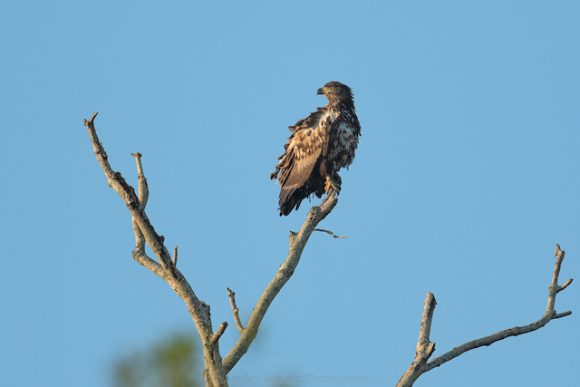
G318 has remained in Lincolnshire since, favouring several areas with quiet woodlands on private land in the Lincolnshire Wolds, where rabbits are numerous. Then, on 4th November she flew further south into the Fens, flying to the coast near Friskney, between Gibraltar Point and Freiston Shore, on 5th November, and then heading back inland. She has remained in the Fens since.
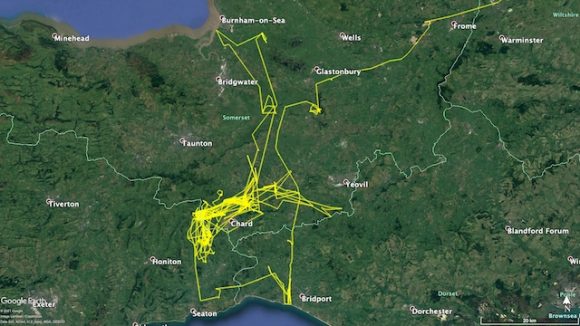
Like G324 who returned to the Isle of Wight after two months in southern Scotland, we expect G318 to return to the South Coast at some point, but she is clearly in no hurry to continue south yet. In fact there is every chance that G393 and G318 will meet up again at some point over the coming weeks. The two birds were just 16 miles apart on the afternoon of 5th November, albeit on different sides of the Wash. On a clear day there is every chance they will be able to see each other.

G318 over the Lincolnshire Fens (photo by John Clarkson)

2020 Juveniles

It is now more than three months since this year’s cohort of juveniles were released on the Isle of Wight, and, to date, three have made exploratory flights away from the Island.

G461

The first of this year’s cohort to leave the Isle of Wight was juvenile male, G461. He crossed the Solent and Southampton Water on the morning of 30th September and then continued into the South Downs.

He spent the next five days exploring several wooded areas in the Meon Valley in Hampshire, before roosting in woodland just north of Alton on 5th October. He was seen nearby by Hampshire county bird recorder, Keith Betton next morning but then headed north-east, passing over Farnborough at 11:50. At 12:40 he was perched in a wood a mile north-west of the M25/M3 junction and then crossed the busy motorway and skirted across the south-west of London, passing over Queen Elizabeth II reservoir at 14:05 and then Island Barn Reservoir soon afterwards at an altitude of 438 metres.  Half an hour later he was over Coulsdon and then at 15:40 he was perched in a wood 2.5 miles south of Oxted. He roosted nearby having flown 52 miles during the course of the day. 

G461 skirted across the south-west of London during the afternoon of 6th October

G461 was active soon after first light on 7th October and headed south-east. At 13:36 that afternoon he was over Eastbourne on the South Coast and then headed north-east over the Pevensey Levels. He continued flying for a further ten miles before settling in an area of woodland 1.5 miles north of Darwell Reservoir having flown a further 51 miles that day. 

Next morning G461 flew to Darwell Reservoir and remained there all day, favouring the wooded south-west corner.  He returned to the coast at Pevensey Bay on the morning of 9th October before heading north, passing half a mile to the north of Arlington Reservoir at 13:10 and then onwards to Buckhurst Park near Crowborough, having travelled 38 miles through the Sussex countryside .

G461’s movements in East Sussex, 7th-11th October

G461 remained in the local area on 10th October, but then flew south-west during the afternoon of 11th. At 14:45 that afternoon he was flying west over Portslade just to the west of Brighton at an altitude of 210 metres, and half an hour later he passed just to the north of Worthing. He then settled in an area of scattered copses north-west of Findon, having flown 35 miles. He remained in the local area all of the next day, but then resumed his journey on the morning of 13th October, passing over Bognor Regis, Pagham Harbour and then Selsey Bill at 11:45. The Isle of Wight was now within sight and he flew 19 miles direct across the sea, making landfall between Luccombe and Ventnor and then roosting in a favoured area of woodland on the Island having flown another 49 miles.

The young male has remained on the Island since, having completed a perfect exploratory flight of 276 miles over the course of two weeks.   

G461’s 14 day flight through south-east England, 30th September-13th October

G461’s initial flight east from the Isle of Wight was made during a period of westerly winds. When the wind turned to the east during October, it resulted in two of this year’s juveniles heading west.    

G471 

G471 was the second of this year’s cohort to leave the Isle of Wight, on 11th October. Rather than making the short crossing over the Solent, the young male headed west from the Needles and flew 18 miles across the sea to Swanage where he was seen passing through Durlston Country Park. From there he headed west along the Dorset coast, passing just north of Weymouth at 13:00 and then stopping for the night in farmland north of Bridport having flown 60 miles from the Isle of Wight.

G471 flew 60 miles along the Dorset coast on 11th October

He remained in the local area on 12thOctober, but then flew to Lyme Regis on the morning of 13th before following the Devon coastline west, passing to the north of Seaton at 13:00, before cutting inland and eventually settling in farmland north of Clyst St Lawrence, 8 miles north-east of Exeter.

Next morning G471 resumed his flight at 10:30 and headed west through central Devon, flying at altitudes of less than 250 metres. At 12:30 he had stopped in farmland north of Holsworthy, having flown 45 miles. He remained in the local area all afternoon and then flew 10 miles west to woodland along the Coombe valley on the Cornish coast north of Bude on 15th October. 

On 16th October G471 flew north up the coast, back into Devon. He paused for over an hour on coastal cliffs at Hartland Quay where he was seen by David Pearman and two friends.  Then, at 10:20, he headed out across the sea towards the island of Lundy, completing the 12 mile crossing in just under 25 minutes. Once he was over the island he was seen at close quarters by Tim Davis and Tim Jones, and then flew north to the northern most point of the island, where he perched on rocks for 20 minutes at midday. He then headed back south, and was watched again as he circled over the sea and then drifted back towards the North Devon coast. This was the first White-tailed Eagle sighting on Lundy for 140 years and you can read a fantastic account on the Lundy birds blog, written by Tim Jones.  

The return crossing took G471 35 minutes and, once back on the mainland he followed the coast 3 miles east, before settling in woodland north-west of Clovelly. Next day, G471 headed further south, and then remained in an area close to the River Tamar north-east of Bude for over a fortnight.

G471 flew to Lundy and back to the Devon coast on 16th October
G471’s flight across Lundy on 16th October

On 4th November G471 flew south-west, covering 59 miles in three hours, before stopping near Stithians Reservoir at 14:40 and roosting nearby. Next morning the young male continued south-west, passing over Penzance at 10:40 and then continuing towards Land’s End. An hour later he was circling two miles east of Land’s End, and just as G463 had done before (see below), he then turned around and headed back north-west. He passed over Camborne at 13:45 and then roosted in an area of scattered woods south-west of Truro. Since then G471 has headed further north-east through Cornwall. It will be interesting to see if he lingers in the South West, or heads back to the Isle of Wight.

G463

G463 was the third of this year’s cohort to cross the Solent. The young male set off from the Needles to Barton on Sea at 14:00 on 13th October, and then headed west, skirting the north side of Bournemouth before roosting in woodland near Kingston Lacy, six miles north of Poole Harbour. Next morning, encouraged by a strong easterly wind, G463 left his roost site soon after 07:00 and again headed west. He paused for an hour in fields to the west of Axminster, and then continued through Devon, passing to the north of Exeter at 12:30. He eventually stopped for the night at 16:00 in a wooded area between the Devon villages of Hatherleigh and Highampton after flying 93 miles.  Interestingly he was now just 12 miles west of G471 who had followed a very similar course west through Devon earlier the same day. 

On the morning of 15th October G463 remained around the local area until 10:30 when he again headed west. An hour later he had flown 23 miles and was circling just off Cornish coast north of Crackington Haven. He then followed the coastline south-west and was photographed by Pau Ash and Graeme Willetts over Hawker’s Cover near Padstow around midday. By 14:05 he was just to the north-east of Penzance and continued to the coast just to the south of Land’s End. Clearly not wanting to fly out to sea, he turned around, and then headed east to the south of Penzance and eventually stopped to roost in woodland near Relubbus, 6 miles to the north-east. He had flown 106 miles from his roost in Devon. 

G363 was photographed by Paul Ash as he flew over Hawker’s Cover near Padstow in Cornwall on 15th October

Next morning G463 headed south-west again and passed over Mousehole and then west to The Brisons, a rocky islet just under a mile off the coast near St Just, where he perched for three hours from 12:00-15:00. He then headed north-east along the coast to St Ives, flying low across St Ives Bay soon afterwards before settling to roost in nearby woodland.  

G463 remained around the woodland close to St Ives Bay all day on 17th before slowly heading 16 miles east on 18th, passing to the north of Camborne and then spending the afternoon beside the Truro River, just to the south of the city. 

Next morning the young male headed 6 miles north-east to woodland between Tregony and Grampound, but then made a more concerted movement to the east on 20th October, crossing St Austell Bay and the following the coast east to Plymouth. At 13:45 he was flying 86 metres above Plymouth docks and soon afterwards was perched near Crownhill Down, 7 miles to the north-east. 

G463’s flight around the Cornish coast 14th – 20th October

G463 remained in the local area for the next two days, and then flew south-east to the Devon coast just north of Start Point on the morning of 23rd October, before continuing north along the coast, and crossing Tor Bay at low altitude to Torquay. That night he roosted in woodland just to the north of Meadford beach, having flown 35 miles from Plymouth. Next day he left the roost site at 07:30 and spent several hours in woodland south of Watcombe Head, before flying 6 mils north and spending the remainder of the day in farmland north of Newton Abbott. On 25th he continued north-east, crossing the Exe estuary at 09:00 before lingering in arable farmland just to the east of Exeter and roosting in woodland nearby. He then flew a further 19 miles north-east to an area close to the Devon-Somerset border on 26th.

G463 has remained in the local area since and, like G471, it will be interesting to see whether he remains in the South West, or returns to the Isle of Wight. Whatever the case, like his compatriot from the Isle of Wight, the young male will be building up valuable knowledge and experience on these fascinating explorations.

G463 (yellow) and G471 followed similar tracks towards Land’s End, albeit several weeks apart
G463 (yellow) and G471 (white) have both been exploring the South West since mid-October

Can you help us?

Satellite tracking is a key element of the project, and as such, a core cost that we have to cover. Donations of any amount make a big difference, and so if you are able to make a contribution, please click the donate button below and select White-tailed Eagle project when prompted. Any donations, no matter how small, are very gratefully received. The Foundation relies on the generosity of our supporters to carry out our various projects. If you like what we can do, please click here to find out how your support can help us.

Traversing the Sahara

Having negotiated two long sea crossings, including a 28 hour flight across the Mediterranean from the south of France to Algeria, the next challenge for the young honey buzzard on her first migration south from Scotland, was to cross the Sahara. This is one of the hazardous elements of the journey and previous satellite tracking studies have shown that many young raptors perish as they attempt to cross the vast and unforgiving terrain.

The satellite tag, which has enabled us to follow her journey south in such precise detail, logs the bird’s location as regularly as once every minute, and then transmits the data at pre-determined intervals when within range of a mobile phone mast. This meant that as she headed across the Sahara – where mobile phone coverage is patchy at best – it was likely we would have to wait some time before receiving an update on her progress. That long-awaited update finally arrived over the weekend, and we were delighted to see that she had reached the River Niger in Mali, having flown 2678 km across the Sahara in 11 days.

In our last update we reported that the young bird had reached the northern edge of the Sahara on 29th September. She set-out across the desert the next morning and flew 205 km south-east to the Atlas Saharien Mountains, where she roosted at an altitude of 1675 metres.

The honey buzzard spent the night of 30th September roosting at an altitude of 1675 metres.

The next morning, 1st October, she resumed her journey south 1.5 hours after sunrise, at 07:30 GMT. Unlike the previous day she maintained a south-westerly heading all day, reaching a maximum altitude of 1766 metres (above ground level) as she flew across the desert during the afternoon. She eventually settled to roost on the ground at 17:30, having flown exactly 300 km during ten hours of non-stop-flight.

Whilst her course had been directly south-west on 1st October, it was very different the next day. She resumed her journey at 07:45, initially on the same south-westerly heading as the previous day. However at 09:40 she turned and flew 24 km north-west in 2.5 hours, before turning 180 degrees at 12:07 and then flying back in the opposite direction. There is no way of knowing what caused this sudden change of course, but perhaps she encountered other migrating honey buzzards, and joined them? Whatever the case, she maintained the south-easterly heading for the rest of the day before stopping to roost at 17:00. She had flown 183 km during the day, but thanks to two changes of direction, had actually only travelled 92 km south-east from her position overnight.

The honey buzzard flew 182 km on 2nd October, but actually only covered 92 km due to two changes of direction

On the morning of 3rd October, she left her roost site on the desert floor at 08:30 and flew 124 km south-west. At 14:00 she was circling over the remote village of Zaouiet Debagh and at that point changed course to the south-east, flying a further 56 km before stopping to roost at 17:00.

The honey buzzard made a later start the next day, remaining at the roost site until 09:35. When she did resume her journey it was on the same south-easterly heading as the previous evening. By 16:00 she had travelled 174km, and at that point she turned to an easterly course, and continued onwards for another 71km. She eventually settled to roost at 17:30, having flown 245 km during the course of the day, reaching a maximum altitude of 1952 metres during the afternoon.

Unlike the previous two days, the young honey buzzard maintained the same SSE heading throughout the day on 5th October, leaving her roost site at 08:45 and flying 269 km in just under nine hours. That night she roosted on a rocky hillside above what appeared to be an ephemeral river bed.

The honey buzzard roosted on a rocky hillside on 5th October

The next morning she landed beside the river bed for approximately 15 minutes, suggesting it may have contained some water. She then resumed her migration at 08:45.

Conditions must have been favourable for migration because she made excellent progress during the course of the day, flying 404 km on a south-westerly heading. The thermal updrafts were obviously very strong because during the afternoon she was circling up to more than 3000 metres on occasion. In fact as she passed over a mountainous region, she reached a maximum altitude of 3133 metres above ground level.

The honey buzzard flew at very high altitude over mountains during the afternoon of 6th October.
The honey buzzard’s flight from 30th September to 5th October, with overnight roosts shown by the white arrows

She left her roost site at 07:30 on 7th October and again flew strongly south-west, crossing the border into Mali at 12:02, and flying at an average speed of 54 km/h. She maintained the same heading all day, flying at altitudes of over 2000 metres, and eventually settled to roost on the desert floor just before 17:30 having flown 503 km in 11 hours of non-stop migration.

After two very good days of migration, conditions evidently became more difficult on 8th October. She left her roost site at 08:30 and initially flew 54 km south-west. However, she then changed course by 90 degrees, switching to a south-easterly heading at 11:30. She subsequently travelled a further 70 km before stopping much earlier than usual at 15:20. She had flown 124 km at an average speed of 18 km/h, but due to the change of direction, had actually only covered 87 km south from her overnight roost.

It appears from the Google Earth imagery that she may have roosted in a vegetated area – suggesting it may have been possible to find food.

After flying 503 km on 7th October, the honey buzzard managed just 124 km the next day and due to the nature of her flight, actually only covered 58 km south

The suspicion that she may have been able to feed around the roost site was given further credence by the fact that she left much later than usual the next morning, not setting off until 10:10. When she did resume her journey the honey buzzard flew WSW for 169 km before turning to a southerly heading at 16:22. She continued flying until 17:30, covering a further 49km, and thus a total of 169 km during the course of the day.

On the morning of 10th October she left her roost at 09:50, initially flying due south, and then turning to the south-west at 11:00. At 14:35 she was approaching the north shore of the vast River Niger and then, twenty minutes later, was perched on the ground nearby. She remained in the local area for the rest of the day.

After 11 days and 2678 km, she had successfully crossed the Sahara. Her daily distances on each day of the Saharan crossing are shown in the table below.

DateDistance flown (km)
30-Sep205
01-Oct300
02-Oct183
03-Oct180
04-Oct245
05-Oct269
06-Oct404
07-Oct503
08-Oct124
09-Oct169
10-Oct96

Yesterday the young honey buzzard flew across the River Niger just after 09:30 and then perched close to the south bank of the river for the next half an hour.

The honey buzzard remained around the River Niger during the afternoon of 10th October and then all day on 11th.

Having successfully crossed the desert, it will be fascinating to see where the young honey buzzard goes next. It is now a month since she left her nest site in Moray and she has made excellent progress so far. Will she continues south towards Burkina Faso and Ghana, or south-west towards Guinea? We’ll have another update soon.

Flight between 6th and 11th October
The honey buzzard has flown 2678 km across the Sahara in 11 days
The honey buzzard has travelled to southern Mali in a month since leaving its nest site in Moray on 11th September

Amazing flight across the Mediterranean

Wow. In our last update we reported that the juvenile honey buzzard had reached the Massif Central region of southern France, having got back on track after its initial flight east across the North Sea from Scotland to Denmark. We suspected it would continue on a south-westerly heading into Spain and then onwards towards the Strait of Gibraltar, where it would require only short sea crossing to North Africa. That’s exactly what an experienced adult would do, but previous satellite tracking studies have shown that the routes used by juveniles can be much more variable. And so it has proved in this case. The latest satellite tracking data shows the juvenile female has made an incredible 1001 km crossing of the Mediterranean from the south of France to Algeria.

In our previous update rain had halted her progress through France and she spent two days beside the Allier River near Clermont-Ferrand. The weather improved on afternoon of 27th and she resumed her journey south at 12:35, flying an impressive 254 km almost due south in just over four hours, to a wooded area 15 km west of Montpellier.

It seemed that the young honey buzzard was now keen to make up for lost time and she resumed her journey much earlier than usual, at 08:00 the next morning. Forty minutes later she reached the Mediterranean coast, but rather than follow the coastline south-west, as we expected her to do, a strong north-westerly wind of 27 km/h resulted in her heading out to sea.

The wind strengthened and turned more north-easterly as she headed south and, at 13:00, she was flying south over Menorca, having flown 393 km across the sea at a very fast average speed of 87 km/h, at altitudes of between 300 and 750 metres.

The young honey buzzard flew at speeds of up to 87 km/h as she set-off across the the Mediterranean from Montperllier

She did not make landfall in Menorca, and instead continued south-west with the wind now 43 km/h from the north-east. She flew 183 km south-west over the next 2.5 hours at an average speed of 73 km/h and a maximum altitude of 1068 metres.

The wind eventually dropped and turned to the east as the afternoon progressed, and this was reflected in the bird’s flight path. Rather than continuing south towards the Algeria coast, she drifted further and further to the west, flying parallel with the North African coast by evening, but still over 100 km out to sea.

By 20:30 her flight speed had dropped to 23 km/h and she was flying due west, having now flown 746 km across the Mediterranean in 12 hours of continuous flight.

As the wind dropped and turned more easterly the honey buzzard drifted further west, and may have landed on a boat for a short period during the night

She maintained the same westerly heading as darkness fell, and then almost certainly rested on a boat because she only flew 11 km in two hours between 00:32 and 02:33. By 06:32 she had flown 141 km in ten hours overnight.

As dawn broke she made a very definite turn to the south, and then south-east. Despite the fact she was now flying into a slight headwind, she maintained a definite course towards the Algerian coast, flying 115 km in just over six hours at altitudes of between 50 and 200 metres and eventually made landfall at 12:50. By the time reached the Algerian coast between Ouled Boughalem and Tenes, she had flown 1001 km over the sea in a little over 28 hours, a remarkable flight for a young bird on her first migration south.

She changed course at first light on 28th and eventually made landfall in Algeria
She flew 1001 km across the Mediterranean in just over 28 hours

Despite reaching land, the young honey buzzard showed no signs of letting up and she flew a further 160 km south-south-west, before roosting in mountains on the northern edge of the Sahara. She had covered 1180 km since leaving her roost site in France 35 hours earlier.

The honey buzzard flew 1180 km in 35 hours

Yesterday she remained in her roosting area all morning, and then, after an initial movement 10 km north, she flew 60 km south-west through the mountainous Saïda province of north-west Algeria, before roosting in one of the last remaining wooded areas on the north side of the Sahara.

After two very long sea crossings, the young honey buzzard now faces another daunting challenge – her first flight across the Sahara.

The young honey buzzard is now on the northern edge of the Sahara, after flying a further 60 km south-west yesterday
She has made two very long sea crossings, both strongly influenced by the wind, since leaving Scotland

A stop-over in the Massif Central

In our previous update the young honey buzzard was roosting in eastern Belgium, close to the Luxembourg border. She has continued on south-westerly track through France and is now in the Massif Central in central-southern France where rain has interrupted her journey. She has spent the past two days in woodland on the banks of the Allier River near Clemont-Ferrand.

On the morning of 21st September she made short local movements in woodlands close her roost site in eastern Belgium before setting off in earnest at 11:00. Forty-five minutes later she was passing over the town of Bastogne at an altitude of 876 metres and she continued south-west through the rolling hills and forests of the Ardennes over the course of the next few hours before crossing the border into France at 13:35.

Conditions for migration were good with a light northerly wind and warm sunny conditions perfect for the formation of thermal updrafts. At 16:00 the GSM transmitter logged her altitude as 1686 metres as she circled high in a thermal. She maintained an almost perfect south-westerly heading all afternoon and eventually settled to roost in a large area of forest in the south of the Champagne-Ardenne region of north-eastern France, having flown 246 km at an average speed of 33 km/h during the course of the day. Her textbook migration suggests that, by now, she may well have joined other migrating honey buzzards as she heads south.

A light tailwind helped the honey buzzard fly 246 km through the Ardennes and into France on 21st September

On the morning of 22nd September the young honey buzzard made short local movements in the forest soon after first light, and then resumed her journey south at 10:50. She initially flew due south but, after crossing into the Burgundy region at 11:45, she reverted to a more south-westerly heading.  Although she was flying into a light headwind, it was clear the conditions for soaring were again good, particularly during the afternoon when she reached a maximum altitude of 1715 metres.

Conditions for soaring flight were very good on 22nd September, allowing the honey buzzard to circle up to altitudes of over 1000 metres before gliding onwards (flight left to right)

By 15:46 she had flown 107 km and at that point she again turned due south and flew another 63 km before pausing in a forested area in the south of Burgundy for half an hour at 18:00. She then flew another 9 km before settling to roost at 19:00 in an area of forest south of Toulon-sur-Arroux after a day’s flight of 179 km, at an average speed of 24 km/h.    

She flew 179 km on 22nd September

Next morning she moved between small woods in farmland a few kilometres south-west of the roost site, and also landed in fields on several occasions.  At midday she was perched in riverside trees just north of the town of Gueugnon, having only flown 10 km during the morning. She set off again soon afterwards and this time made a more purposeful move to the south-west, skirting around the north side of Gueugnon and then circling up to an altitude of 843 metres. She flew 85 km south-west over the next 3.5 hours, circling up to altitudes in excess of 1000 metres and at 15:30 was crossing the Allier River at Saint-Yorre.

It was clear from her flight altitude that conditions for migration were now deteriorating, and she flew at low altitude for the rest of the afternoon, travelling a further 40 km before settling to roost in woodland close to the Allier River, just north west of the town of Pont du Château and close to the capital of the region, Clemont-Ferrand. She had flown 135 km during the course of the day. 

The honey buzzard flew 153 km on 23rd September

Rain and low cloud meant that the young honey buzzard remained in the same area on 24th and 25th, perching in woodlands on the banks of the river. Better weather is forecast for today, so it will be interesting to see if she continues her journey south. 

The honey buzzard has spent the last two days in woodland on the banks of the Allier River
Flight between 21st and 25th September

We featured the migration of the honey buzzard in our latest podcast. You can listen online below.